
Agent bills are moving to the control plane
AgentSysBench found tools or environments dominated latency in half its agent apps. Meter model, tool, state and waiting costs together at the control plane.
AgentSysBench counted 4,641 benchmark requests, 64,924 model calls and 118,274 tool calls across ten agent applications. Its August 15 paper then added 178,799 production sessions. In five of the ten applications, tools or environments dominated or co-dominated latency. One sandbox reached a 28 GB working-set peak during compilation and tests.
Those numbers do not prove that the model has become cheap. They prove that a token bill cannot describe an agent task. The control plane is becoming the cost-allocation boundary because it is the only layer that sees model calls, tool runtime, retained state, waiting, retries and the final accepted result together.
That is what “agent bills are moving to the control plane” means. It is an accounting instruction, not a forecast that every company will spend more on CPUs than GPUs.
The cost leaves the model before the task finishes
The AgentSysBench paper makes the split visible. Its pay-as-you-go estimate combines public pricing for model APIs, E2B sandboxes and Firecrawl search. In the tool-heavy Pi-AutoR workload, sandbox charges made up more than 99% of the estimated per-request cost. That is one scientific-simulation workload, not a universal ratio, but it is enough to break model-only budgeting.
The production traces expose a second bill: resources held while nothing executes. Across 35,037 coding-agent sessions, the median session was active for only 20% of its lifetime, and 70% were active for less than half. The sandbox still held correctness-critical state while the agent waited for a model, a tool or a person.
Cache policy made that waiting expensive. The paper reports that 59.4% of those sessions suffered at least one cache eviction; re-creating evicted prefixes accounted for an estimated 31.5% of aggregate monetary cost under the stated model prices. A short next action can therefore carry the prefill cost of a very long history.
The embedded earlier 40-second video argued that routing, memory, loops and gates move control outside the model. Its evidence is Cyera's vendor analysis of reported incidents, so use it for the architectural frame, not as a cost benchmark. AgentSysBench supplies the missing systems measurement.
Intel's filing supports a narrower claim
Tomasz Tunguz's August 23 cost-stack essay connected agent demand to a move from roughly one CPU per eight GPUs in training toward one-to-one for agentic workloads. It also relayed “billions” in unmet Xeon demand. Those are memorable numbers. I could not find either one in the cited Intel filing, so they should not become facts by repetition.
The Q1 2026 10-Q says something useful and narrower: data-centre revenue rose 22%; server average selling prices rose 27% while volume fell 5%; and demand exceeded available supply. Intel attributes the ASP increase mainly to a richer premium-product mix and pricing actions partly offsetting higher input costs. Its earnings release separately quotes CEO Lip-Bu Tan saying the move from inference to agentic AI is increasing CPU demand.
That is hardware context, not proof of an agent-specific CPU-to-GPU ratio. The control-plane thesis does not need the bigger claim. The measured software stack already shows CPU-bound sandboxes, memory-bound retrieval, network-bound services and GPU-bound inference competing inside one task.
Put the meter where the task has an identity
The model provider can price tokens. A sandbox provider can price runtime. Neither knows whether the task eventually produced accepted work, failed review or repeated an earlier search. The orchestrator does.
This historical repair is a small example I can document. Model work helped produce the draft, but source retrieval, generated media, the local renderer, mobile inspection and validation all sit outside that call. The private review receipt records those boundaries; it does not record their cost split, so I will not invent a percentage.
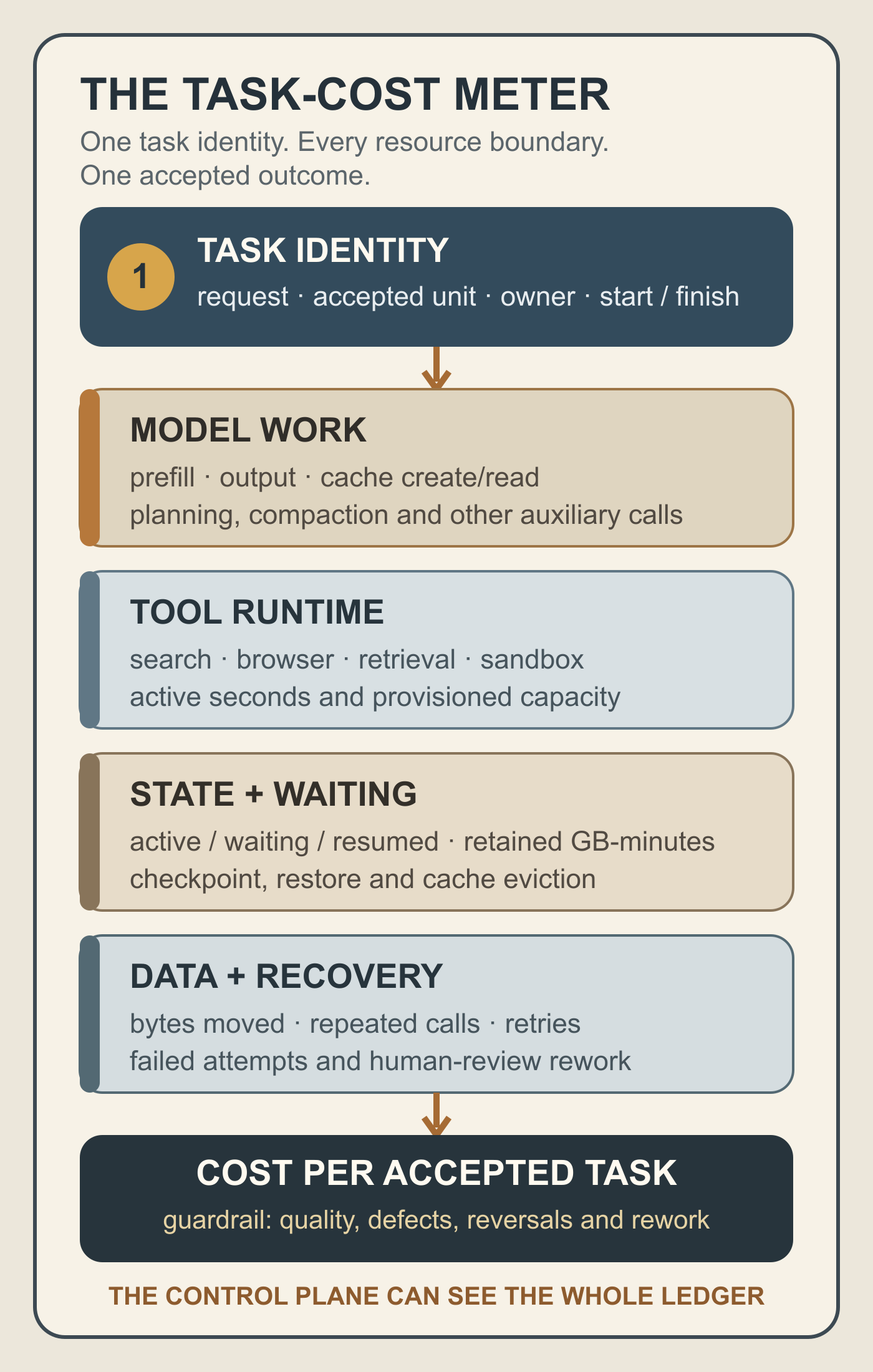
I would put five controls into the task ledger before negotiating another model discount:
- Give every run a task ID and name the accepted unit: merged change, resolved case or approved analysis.
- Tag every charge as model, tool, environment, state or data movement; separate goal-directed calls from planning, compaction and safety work.
- Record active, waiting and resumed time, plus retained memory and checkpoint or restore events.
- Count retries, cache evictions, repeated tool requests and human-review rework against the same task.
- Divide the full cost by accepted output, then keep quality, defects and reversals beside it.
This extends the archive's earlier rule to benchmark the task, not the token. It also explains why queue age belongs in agent routing: waiting is not dead time when state remains allocated or cached prefixes expire.
Three optimisations become finance controls
AgentSysBench tested simple responses to its measurements. Task-aware serving cut latency 29–40%. Proactive sandbox offloading cut average memory use 4.6× with less than 0.5% latency increase in that experiment. A ten-minute tool-result cache removed 35.2% of redundant search calls and saved 19.3% of aggregate search latency in the traced search workload.
Those are research results under specified configurations, not savings promises. Their practical value is that each maps to a ledger line: scheduling, retained state and duplicated external work. Once the control plane records those lines, an infrastructure optimisation can be evaluated against cost per accepted task rather than an isolated benchmark.
The August 18 Agent Lightning v1.0 paper adds one more boundary shift. Its harness owns the environment interaction loop during reinforcement learning while the trainer observes model request-response pairs. The harness is not just generating the bill; it can shape the training trajectory. That result does not quantify serving cost, but it makes model-only ownership look even less complete.
I cannot honestly claim a universal control-plane percentage without traces from the workload being priced. That is precisely the point. If the invoice cannot be joined to a task ID, a waiting state and an accepted outcome, the number is spend—not unit economics.
Price the whole agent task at the control plane; token cost is one meter on the wall, not the building's bill.