Airtable's acquisition price is not a verdict on no-code
Airtable's deal separates enterprise value from equity value. For platform teams, the useful question is workflow portability, not whether one acquisition proves that no-code is dead.
Airtable's announced sale is not a no-code obituary. It is a reason to ask whether the workflows you built can leave.
The internet will turn the deal into a clean story: software made for people got marked down; software operated by agents gets the premium. Neat. Also unsupported by one acquisition.
My read is narrower and more useful. The price does not tell us which interface won. It tells platform teams to stop treating workflow portability as a future problem.
The number everyone will misuse
Bending Spoons' August 4 announcement values Airtable at $1.285 billion in enterprise value. Add Airtable's net cash and cash equivalents, and the release gives an implied equity value of approximately $2.25 billion.
Those are not two versions of the purchase price. Enterprise value prices the operating business after accounting for cash and debt. Equity value is what belongs to shareholders. Swapping one for the other can move the headline by almost a billion dollars before the argument even starts.
The release also reports approximately $480 million in annual recurring revenue as of June 2026, growing more than 20% year on year. Divide enterprise value by that ARR and you get roughly 2.68 times. That is arithmetic on the company's figures, not an audited trailing-revenue multiple. It says nothing by itself about margins, retention, profitability or why the parties accepted the terms.
The transaction was still subject to regulatory approvals and other closing conditions when announced. On August 5, the defensible statement was that Bending Spoons had agreed to acquire Airtable, not that the acquisition had closed.
These distinctions are not finance trivia. If the input is sloppy, the platform decision built on it will be worse.
One deal cannot price the interface
The hypothesis is sharp: the market discounts software built for human operators and rewards software where agents do the work. I still think that is a useful question. This deal cannot answer it.
To make that causal claim, we would need the counterfactual. What would the same company be worth with the same customers, growth, margins, retention and deal structure, but a different operating interface? The announcement does not provide it. Putting another company's larger valuation beside Airtable's does not create the missing control.
That matters because the wrong diagnosis invites an expensive cure. A team can spend months migrating a useful workflow because “no-code is dead” sounded strategic, then discover that the real lock-in was an approval rule nobody had documented.
So I would not use this deal to approve a migration. I would use it to approve an exit drill.
Airtable already had agents inside the product
The human-versus-agent framing breaks down for another reason: Airtable had already made its agent move.
In a June 24, 2025 product letter, Airtable introduced Omni as an agentic app-building assistant that can also edit data, and described agents running repeatable work inside business workflows. Those are Airtable's product claims, not an independent reliability test. But the chronology is clear. The company did not wait for an acquisition announcement to discover agents.
A visual app can hold machine-readable data, automations, permissions, human approvals and agent actions at the same time. Calling that entire system “software humans operate” erases the parts a buyer actually needs to inspect.
Adding an agent does not settle portability either. A conversational interface can make a proprietary workflow faster to create while leaving its rules, identities and dependencies just as hard to move. Generating the workflow and owning a usable representation of it are different achievements.
That extends the archive's earlier split between a disposable dashboard and a governed system of record. This deal adds the exit question: can the rules and history under the interface move with you?
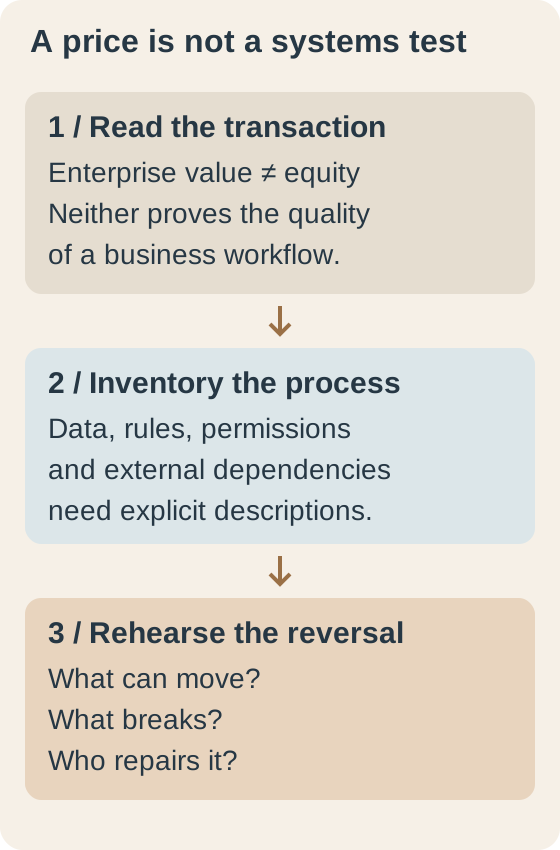
Run the exit drill before the migration
Here is the test I would put into the next platform review. It is a proposed exercise using synthetic records, not a test I have run against Airtable.
Pick one modest workflow with a real consequence: a purchase request that needs approval above a spending threshold works well. Then ask four things.
- Can we describe it? Write down the inputs, approval rule, permitted actors, external dependencies and failure response without relying on the person who built it remembering which buttons they clicked.
- Can we export it? Records are not the whole workflow. Check whether the rules, permissions, automations and downstream identifiers can be reconstructed from documented artefacts.
- Can both operators use it safely? Let a person and a bounded agent attempt the same permitted change in a test environment. Do not widen the agent's access to make the demo pass.
- Can we reverse it? Restore the prior rule. Confirm that pending requests, audit history and external references still make sense. Record every manual repair.
The result is not a portability score for a slide. It is a list of what your team controls, what the vendor controls and what would break if either changed.
That list gives you options. You might keep the platform and document one ugly dependency. You might replace a narrow automation whose permissions cannot be bounded. You might negotiate for better export and API access before expanding usage. All three are more defensible than rebuilding because a deal multiple became a market prophecy.
The platform question is concrete: how long would this process take to move, what would be lost, and which risks can we reduce before we move anything? Those answers survive the next operator, agent and owner.
Treat Airtable's deal as a fire drill for your exit path, not a verdict on the software category.