
Outcome pricing moves the argument, not the risk
Outcome pricing moves failed-attempt cost to the vendor. Buyers still carry risk in the definition, clock, evidence and reversal behind every billed event.
HubSpot’s May earnings call describes outcome pricing in its cleanest sales language: “Customers pay when the agent works.” The company had moved Customer Agent from usage to resolved-ticket credits in April; its product page lists the rate at $0.50 per resolution. Intercom’s Fin lists $0.99 per resolution.
The promise is easy to like. Stop paying for every attempt. Pay when the work succeeds. The vendor now absorbs the failed run.
Only part of the risk moved. The vendor may absorb attempt risk—the cost of answers that never qualify for billing. The buyer still carries classification risk unless the contract handles it: what counts as success, how long success must survive, which evidence proves it and what reverses a charge. Outcome pricing does not end the argument about value. It moves that argument from the token meter into the settlement rule.
A newsletter reported that OpenAI was piloting task-based billing with some large customers. I found no first-party OpenAI announcement and could not inspect the paywalled report behind it, so I am treating that as a market signal, not evidence for any OpenAI contract mechanic. HubSpot and Intercom publish enough detail to examine the mechanic directly.
The invoice settles an event, not the customer’s truth
HubSpot defines a resolution as support provided by Customer Agent followed by no handoff to a human representative for 72 hours. That is a clear, observable rule. It is not the same claim as “the customer’s underlying problem stayed solved.” The clock and the absence of handoff are the billable event.
Intercom’s dated July 30 documentation is more explicit about the state machine. A customer can confirm that Fin’s answer was satisfactory, or leave after an answer without asking for more help, which becomes an assumed resolution. If the customer later returns to the same conversation seeking help, Intercom says the resolution is deducted and not charged. If Fin’s last message was a clarifying question and the customer disappears, it is an abandonment, not a resolution, and is not billed.
Those details are strengths. A named definition, an inspection path and a reversal rule are better than a black-box invoice. They also expose what the buyer is actually buying. “Resolved” depends on the last agent action, the observation window and where a later failure appears. A return inside the same conversation can be visible to a reversal rule. A complaint arriving as a new conversation, another channel or silent churn needs identity and outcome measurement beyond that thread; whether it is connected depends on the buyer’s data and contract, not the word outcome on the rate card.
Fin's documentation says silence after a clarifying question is not billable, and a return to the same conversation can reverse a resolution. One change in message type or conversation continuity can change the invoice even when the customer’s unresolved need looks similar.
The risk moved into settlement
Under usage pricing, the visible argument is volume: tokens, calls, seats or credits. Under outcome pricing, a failed attempt can cost the buyer nothing, but the price now depends on the event classifier around the work.
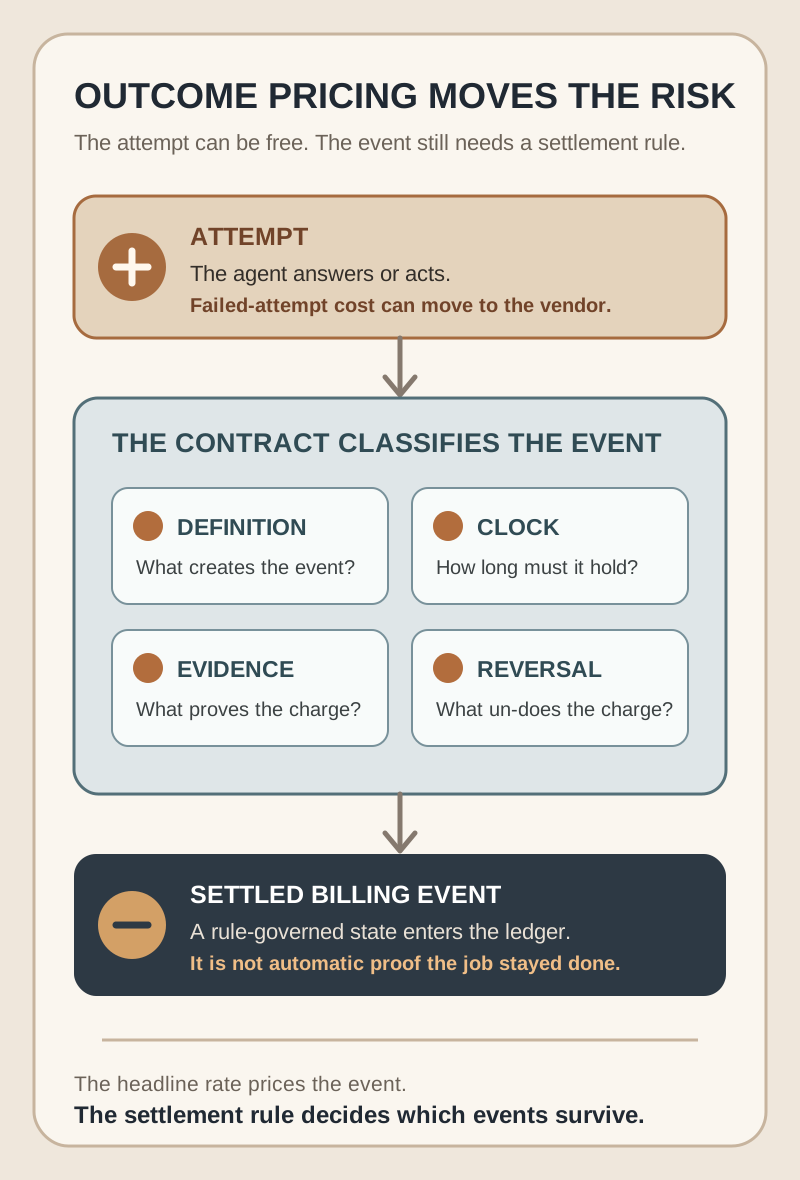
That changes the risk register rather than emptying it. Attribution matters when several systems or a human contributed. Time matters when a ticket reopens after the billing window. Identity matters when the same problem returns through a new thread. Evidence matters when finance wants to inspect the charged events. Reversal policy matters when a provisional success later un-happens.
The unit rate therefore cannot be read alone. Fifty cents against one resolution definition and ninety-nine cents against another are not directly comparable prices. The denominator carries the scope, evidence burden and risk premium. This extends the earlier invoice test for agent scope: once the outcome is definable enough to bill, the next question is who controls its settlement.
Buy the outcome schedule, not the headline rate
Before comparing outcome-priced agents, ask for one charged-event export and negotiate five things:
- Definition: the exact action and customer state that create a billable event.
- Clock: when the event becomes chargeable and how long it must remain true.
- Evidence: the transcript, tool trace and attribution attached to each charge.
- Reversal: which reopen, refund, repeat contact or human correction creates a credit.
- Appeal: who can challenge a classification, against which version of the rule, and within what period.
Then join that billing ledger to customer evidence the vendor cannot see alone: repeat contacts across channels, refunds, complaint reasons, churn signals and sampled quality review. This is not a demand for metaphysical certainty about whether a customer is happy. It is a way to see where the commercial proxy stops matching the operating outcome.
The distinction also keeps containment from masquerading as resolution. A conversation ending without a human can be a useful automation result and a legitimate pricing event. It still needs a separate check for whether the customer’s job stayed done. Billing and service quality can share evidence without pretending they are the same measure.
Outcome pricing is progress when it makes failed attempts the vendor’s problem and charged events inspectable. It becomes theatre when “outcome” is treated as self-defining. The rate gets the headline. The definition, clock, evidence and reversal path decide the bill.
The outcome is not the unit; the settlement rule is. Negotiate that rule before you negotiate the rate.